
Artificial intelligence, or AI, is moving rapidly from predictive tools to agentic systems that act with greater autonomy — able not only to respond to questions, but also to execute tasks and make decisions. Undoubtedly, agentic AI could be transformational for the private sector, holding the power to reshape how businesses operate. At the same time, it has significant potential to accelerate progress toward the Sustainable Development Goals, or SDGs.
For governments, businesses, communities, and the broader development sector, ensuring that the global workforce is ready to adapt is a leading concern. According to Salesforce’s Global AI Readiness Index, human capital mobilization remains the most significant barrier to AI adoption, especially in emerging markets.
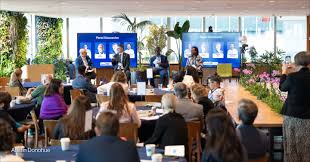
“We know AI and agents, it’s completely changing the way that we work. It’s about reskilling our people to make sure they understand the skills needed to succeed in this era,” Alexandra Legend Siegel, senior vice president and chief equality and engagement officer at Salesforce, said during a high-level event held on the sidelines of the 80th United Nations General Assembly, hosted by Devex in partnership with Salesforce.
Through panel and workshop discussions, policymakers, business leaders, and development practitioners underscored both the risks of widening inequality and the opportunities for inclusive growth if skills, partnerships, and governance can keep pace with innovation.
Trust as a foundation for adaptation
A recurring theme throughout the sessions was the lack of trust in AI technology, which has been a significant barrier to its adoption, not only among workers but also in the communities they serve.
Dr. Ricardo Baptista Leite, CEO of HealthAI, noted past digital transformations in the global health space that resulted in heavier workloads for frontline employees rather than increased efficiency — fueling skepticism toward new tools. Workers also want to understand how AI systems are making decisions and what safeguards exist to prevent bias or error.
To build trust, workers need to see AI integrated in ways that simplify their daily tasks, rather than disrupt them. “There is a need to integrate whatever AI technologies and solutions are developed within the current workflows, so it’s not a major transformation; [rather], it just comes naturally [and] is embedded in day-to-day life,” Baptista Leite said.